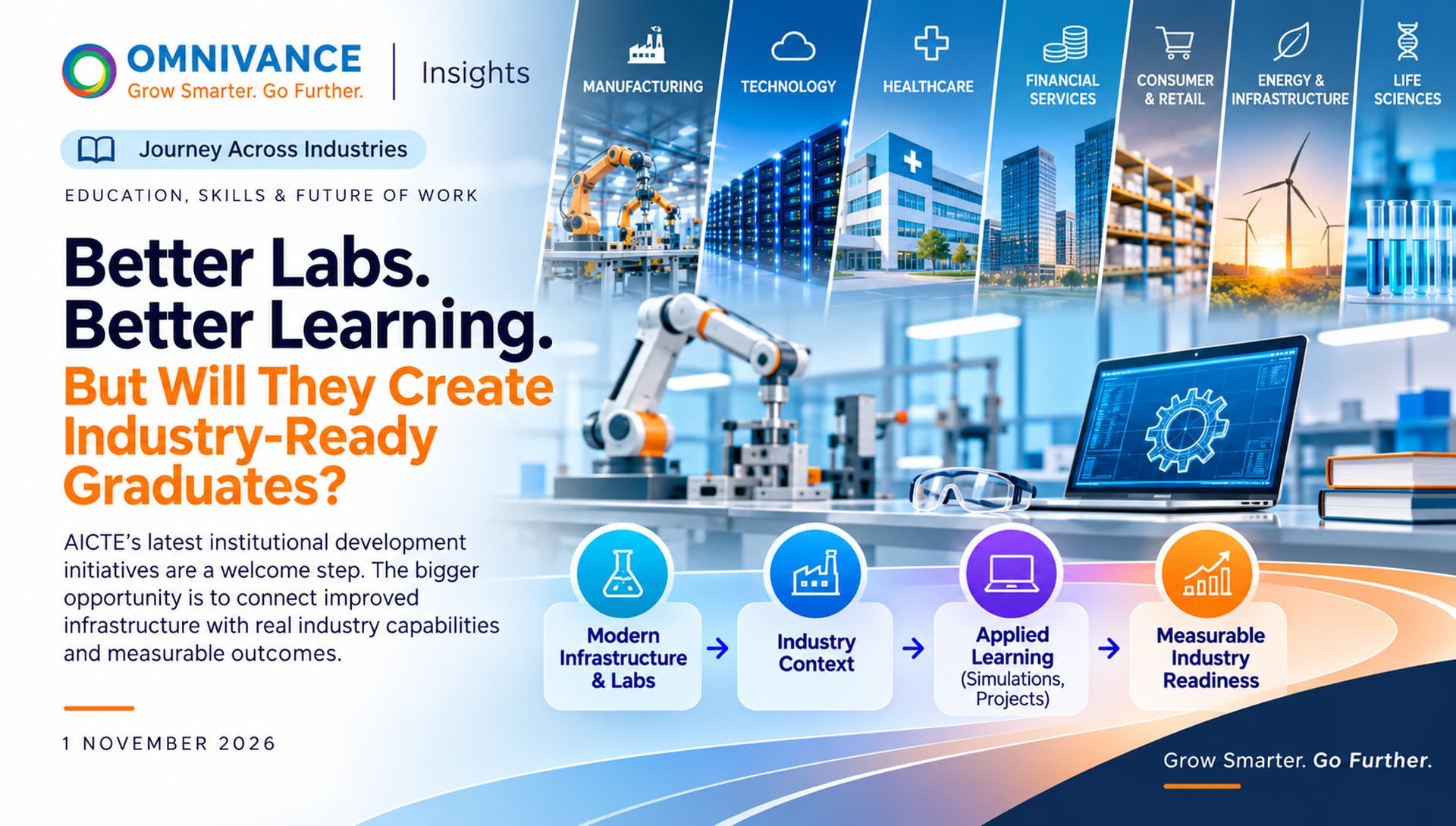

India's ambition to become a global hub for manufacturing, technology and innovation depends on more than investment, infrastructure and policy.
It also depends on the capabilities of the people who will build, operate and improve these industries. That makes the All India Council for Technical Education's (AICTE) latest announcement particularly relevant. For the academic year 2026–27, AICTE has introduced four institutional development initiatives aimed at strengthening technical education, modernising infrastructure, encouraging practical learning and supporting academic collaboration. These are important steps. But they also raise a larger question.
If we invest in better laboratories, are we equally investing in helping students apply what they learn to real industry problems?
Four initiatives, one larger opportunity
The four AICTE schemes address different aspects of institutional development.
IDEA Lab encourages students to experiment, develop prototypes and apply scientific and engineering concepts to practical challenges.
MODROBS supports the modernisation of laboratories, workshops and computing infrastructure, helping institutions improve their facilities for technical education and research.
Margdarshan enables established institutions to mentor other colleges, supporting improvements in academic practices and institutional capabilities.
Grant for Organising Conference (GOC) encourages academic exchange, research discussions and collaboration through national and international conferences.
Together, these initiatives recognise something important: quality technical education requires an ecosystem that supports experimentation, better teaching practices, modern infrastructure and knowledge exchange.
The opportunity now is to connect these improvements more closely with the changing needs of industry.
A laboratory is an enabler, not the final outcome
Consider a college establishing a Smart Manufacturing laboratory. Students may learn to operate sensors, programmable logic controllers, industrial robots and automation equipment. These are valuable technical skills. But what happens when the student joins a manufacturing company? The employer may not simply ask whether the student can operate a particular device.
Instead, the student may encounter questions such as:
Why is a production line experiencing unexpected downtime?
How can equipment data improve productivity?
Should a company automate a particular manufacturing process?
What is the financial return on that investment?
How do quality, safety, cost and delivery requirements influence the decision?
Answering these questions requires more than equipment familiarity. It requires understanding the industry, the manufacturing process, the business problem and the consequences of different decisions.
The real value of a laboratory emerges when students can connect what the equipment does with why a business needs it.
From technical knowledge to industry capability
One opportunity for technical education is to connect four dimensions of learning.
First, industry understanding. Students should understand how the industry operates, its value chain, customers, economics and competitive pressures.
Second, functional understanding. They should understand how manufacturing, operations, finance, quality, supply chain and other functions contribute to business outcomes.
Third, technical application. They should learn how equipment, software, data, AI and automation solve specific operational problems.
Fourth, professional capability. They should develop communication, collaboration, analytical thinking and decision-making skills.
These dimensions are interconnected.
A student who understands industrial automation may know how a sensor works. A student who also understands manufacturing economics can explain how that sensor might help reduce downtime, improve quality or optimise costs. That distinction becomes increasingly important as technology and AI change professional roles.
Industry must become a more active participant
Educational institutions cannot be expected to anticipate every change in industry requirements independently. Employers have an important role to play in defining the problems students should learn to solve. This need not always involve expensive infrastructure or large-scale partnerships. Companies can contribute practical business cases, anonymised operational data, industry projects, role-specific learning objectives and feedback on student capabilities. Faculty members can then connect academic concepts with real applications.
For example, a logistics company could provide a case involving warehouse efficiency. A bank could introduce a scenario involving fraud detection. A manufacturer could present a production-planning challenge. Students could work through the problem, evaluate alternatives, make decisions and explain the business consequences. Such experiences help bridge the gap between understanding a concept and applying it in a professional environment.
Simulations can extend the value of physical laboratories
Physical laboratories are essential where students need hands-on experience with machinery, equipment and engineering systems. But not every business situation can be recreated in a laboratory. A student may operate a manufacturing device without experiencing the consequences of a poor capital-investment decision. A banking student may understand a financial product without confronting a customer-risk scenario.
Digital simulations can complement physical laboratories by allowing learners to make decisions in realistic business situations. A student working in a Smart Manufacturing lab could first learn how the equipment functions, then participate in a simulation where a factory must choose between alternative automation investments. The simulation could introduce constraints involving cost, productivity, quality, workforce availability and return on investment. Students would see not only how technology works, but how organisations decide when and why to use it.
Physical laboratories develop technical experience. Applied simulations can help develop business judgment. Together, they can create a more complete learning experience.
We also need to rethink how success is measured
Traditionally, educational initiatives are often described through measures such as infrastructure created, equipment installed, training hours delivered, certifications awarded or students participating. These measures are useful. They tell us what resources were provided and how widely programmes were delivered. But they do not fully establish whether students are ready to contribute in the workplace.
A more outcomes-oriented approach would also examine whether students can:
Apply technical concepts to unfamiliar problems.
Explain the business purpose of a proposed solution.
Evaluate alternatives using evidence and data.
Work collaboratively across disciplines.
Demonstrate capabilities relevant to actual professional roles.
Institutions could assess these through practical projects, simulations, employer-reviewed assignments and structured capability assessments. Over time, graduate employment outcomes, employer feedback and workplace performance could provide further evidence of effectiveness. The objective should not be to replace academic measures, but to complement them with evidence of practical capability.
A significant opportunity for India's next generation of institutions
One particularly encouraging aspect of AICTE's initiatives is the emphasis on wider institutional participation, including colleges beyond established educational centres. This matters because talent exists across India, while access to advanced infrastructure, industry exposure and professional networks is uneven. Modern laboratories, stronger mentoring and industry-connected learning could help more institutions offer meaningful practical education. However, equipment investment should ideally be accompanied by faculty development, relevant industry projects, learning pathways and clear assessment methods. Otherwise, institutions risk creating impressive facilities without fully realising their educational potential.
The Omnivance Perspective: From learning resources to learning outcomes
At Omnivance, we believe industry readiness begins when learners understand how businesses operate and how their knowledge contributes to real outcomes. Technical education provides the foundation. Industry knowledge gives it context. Practical application makes it relevant. Professional capabilities help turn it into workplace contribution. AICTE's latest initiatives provide an opportunity to strengthen important parts of this ecosystem.
The next step is to bring institutions, employers and learning providers together around a shared objective: not merely creating better facilities or delivering more training, but developing graduates who can apply their capabilities to meaningful industry challenges.
India's next skilling milestone should not be measured only by how many students we train or how many laboratories we establish. It should also be measured by how many learners become ready to contribute.
Better labs are an important beginning. Better industry outcomes should be the destination.
Be Industry Ready. Be Future Ready.
Source: AICTE Institutional Development Schemes 2026–27 announcement, 30–31 October 2026. The four schemes are IDEA Lab, MODROBS, Margdarshan and Grant for Organising Conference. The analysis and recommendations in this article represent the Omnivance Perspective.
Tags
Share this article

Omnivance Research Team
Dedicated to bridging the gap between education and industry requirements.
Related Courses
Deepen your knowledge with these recommended courses