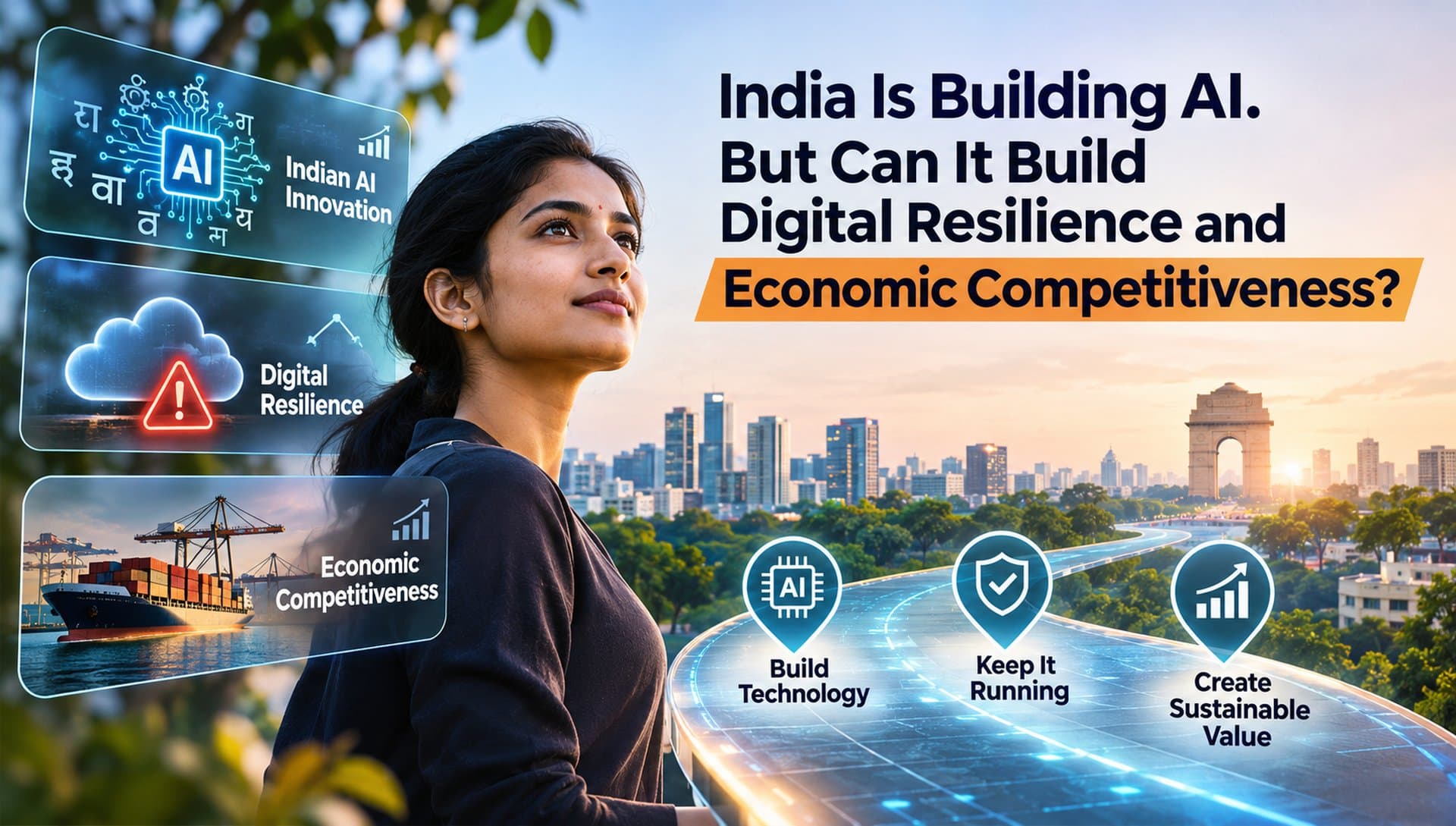

Three developments involving Sarvam AI, Microsoft's service outage and India's merchandise trade deficit raise a bigger question: What does it really take to become a digitally competitive economy?
India is investing in artificial intelligence, expanding its digital infrastructure and aspiring to become a global technology powerhouse. Yet three seemingly unrelated developments offer an interesting perspective on that ambition. An Indian AI company is attracting attention for developing technology designed around India's languages and needs. A disruption affecting Microsoft's services has reminded businesses how dependent they are on digital platforms they do not control. Meanwhile, India's merchandise trade deficit highlights the wider economic realities of operating in a globally interconnected economy.
At first glance, what could an AI startup, a Microsoft outage and international trade possibly have in common? More than we might think. They highlight three dimensions of competitiveness that are often discussed separately: the ability to create technology, the ability to operate reliably using technology, and the ability to compete economically in a global market. And while these developments are not directly connected, looking at them together offers useful lessons for businesses, technology professionals and policymakers.
1. Sarvam AI: Why Building Technology Matters
India has long been recognized for its technology services industry. Indian professionals develop software, manage global technology operations and support some of the world's largest enterprises. But building and delivering technology services is not quite the same as owning the underlying technology. That distinction becomes particularly important in artificial intelligence. Recent reporting about Sarvam AI, an Indian company developing AI models for Indian languages, illustrates the opportunity. The company is working on capabilities intended to serve India's multilingual population and the businesses operating within it.
Consider a simple example. A customer in a small town wants to contact a bank, insurance provider or government service in their preferred language. They may be uncomfortable typing in English or navigating a complicated application. An AI-powered voice interface that understands local languages could make that interaction considerably easier. The business opportunity is not simply to create another large AI model. It is to solve problems that are particularly relevant to India's population and economy.
That requires more than AI research. Companies must develop affordable products, integrate them into existing systems, maintain reliability, protect customer information and demonstrate measurable business value. It also creates opportunities across several professional disciplines, including AI engineering, product management, language technologies, data engineering, user experience and responsible AI governance. The larger lesson is that technological competitiveness increasingly depends on the ability to develop useful intellectual property and products, not merely implement technologies developed elsewhere. However, creating technology is only the first part of the challenge.
2. The Microsoft Outage: When Digital Dependence Becomes a Business Risk
Imagine arriving at work and discovering that your email is unavailable. Your team cannot access important conversations. A client is waiting for a response. A critical approval is delayed. For many organizations, this is more than an inconvenience. The recent disruption involving Microsoft's enterprise services illustrates how closely everyday business operations are connected to digital platforms. Organizations depend on email, collaboration tools, cloud applications and other shared services to coordinate work across locations, customers and suppliers. These platforms have made businesses considerably more productive. But they also create dependencies that may not be obvious until something goes wrong.
A company may have excellent employees, sophisticated applications and strong cybersecurity controls, yet still experience disruption because an external service is unavailable. Does that mean organizations should stop using global technology platforms? Certainly not. The more useful question is whether businesses have designed their operations to continue when critical systems become temporarily unavailable. For example, a consulting organization might need alternative ways to communicate with clients. A manufacturing company may need contingency procedures when a cloud-based application is inaccessible. A financial institution may need clearly defined incident-response and recovery processes.
Importantly, resilience does not always mean maintaining duplicate versions of every technology platform. That could be prohibitively expensive and unnecessarily complicated. Sometimes the better answer is a combination of alternative communication channels, documented procedures, recovery priorities, offline access to essential information and regular continuity testing. Technology leaders therefore need to think beyond implementation and availability targets. They must understand which business activities are critical, what happens when a service fails and how quickly operations can recover.
This is where cloud engineering, site reliability, enterprise architecture, cybersecurity, risk management and business continuity increasingly intersect. Digital maturity is not measured only by how much technology an organization adopts. It is also measured by how effectively the organization manages its dependence on that technology.
3. India's Trade Deficit: Why Economic Competitiveness Still Matters
Now consider a third development that initially appears unrelated to artificial intelligence or cloud infrastructure. India's merchandise trade deficit. A trade deficit occurs when a country imports more goods than it exports during a particular period. According to the Reuters figures cited in the original news report, India's merchandise exports in October 2026 were approximately $49.47 billion, compared with imports of $89.35 billion, resulting in a deficit of about $39.88 billion.
A merchandise trade deficit is not automatically a sign of economic weakness. Imports may include energy, machinery, industrial inputs and equipment that support investment and future production. The broader economic picture also includes services trade, which is not captured in merchandise figures. Nevertheless, trade data raises an important question about competitiveness. How can businesses create greater value while managing the costs and risks of participating in global supply chains?
Consider an Indian electronics manufacturer. Its products may be designed locally, but some components, equipment or materials may come from international suppliers. Changes in exchange rates, import duties, logistics costs or global supply availability can affect production economics. The company must decide whether to diversify suppliers, develop local alternatives, redesign products or adjust its pricing strategy. Technology can support these decisions through demand forecasting, supplier analytics, scenario modelling and better visibility into inventory and procurement.
But technology alone does not solve the underlying economic challenge. Business leaders still need to understand margins, productivity, investment requirements, customer demand and international competition. This is where the connection between business knowledge and technology becomes particularly valuable.
A data analyst who understands supply-chain economics can often contribute more than someone who only knows how to build a dashboard. Similarly, a technology leader who understands cost structures and operational constraints can make better investment decisions. The trade deficit does not establish that technology imports are responsible for India's external trade gap. Nor does it prove that the deficit is directly restricting AI investment. Its relevance here is broader: technological ambition must ultimately translate into economically sustainable business value.
4. Three Developments, One Bigger Question
What do these stories collectively tell us? Sarvam AI highlights the importance of developing domestic technological capabilities. The Microsoft disruption highlights the importance of operational resilience in an increasingly interconnected digital economy. India's merchandise trade position highlights the continuing importance of productivity, value creation and economic competitiveness.
These are distinct challenges. They require different policies, investments and business decisions. Yet they point toward a common principle.
Building technology creates capability. Keeping it running creates resilience. Making it economically sustainable creates competitiveness.
An organization may be innovative but operationally fragile. It may have reliable systems but struggle to create differentiated products. Or it may invest heavily in technology without generating sufficient commercial returns. Long-term competitiveness requires organizations to balance all three dimensions. This is particularly relevant as artificial intelligence becomes embedded in business operations. AI investments will increasingly be judged not only by technical sophistication, but also by reliability, cost, governance and measurable outcomes.
The question is shifting from *“Can we build or adopt this technology?”* to *“Can we create lasting value from it?”*
5. What Does This Mean for Careers?
For students and working professionals, these developments offer an important lesson. Technology careers are becoming increasingly interconnected with business operations, industry knowledge and economic decision-making.
An AI engineer needs to understand how a model will be used, what it costs to operate and how its performance will be evaluated. A cloud professional needs to understand business continuity, service dependencies and operational risk. A supply-chain analyst needs to connect data with procurement decisions, inventory economics and supplier performance. And a business leader needs enough technology understanding to ask the right questions, evaluate trade-offs and make informed decisions.
This does not mean everyone must become an expert in AI, cloud computing and international trade. Instead, professionals can build their careers around three complementary capabilities:
Domain understanding: Knowing how an industry or business function actually works.
Technology understanding: Knowing how digital tools, data and AI can improve decisions and operations.
Business judgment: Understanding cost, risk, customer value and the practical consequences of decisions.
The combination matters because technology rarely creates value in isolation. It creates value when people understand the problem being solved and the business outcome being pursued.
6. The Bigger Lesson for India's Digital Future
India's technology journey has evolved significantly over the past few decades. From delivering technology services for global enterprises, the country is increasingly exploring opportunities in AI products, digital platforms, advanced engineering and technology-led innovation. That evolution is encouraging.
But the next phase of competitiveness will require more than technological ambition. It will require dependable infrastructure, resilient organizations, commercially viable innovation and professionals who can connect technology with business value. The three news developments discussed here do not tell one continuous story. They do, however, provide three useful perspectives on the same strategic question.
How do we move from being a major participant in the global digital economy to creating more distinctive, reliable and sustainable value within it? Perhaps the answer lies in recognizing that innovation, resilience and economic discipline are not competing priorities. They are complementary foundations of long-term competitiveness. And that is a lesson worth considering not only for India, but for every business and professional navigating an increasingly digital world.
*Omnivance Insight | Industry Intelligence*
*This article draws on reporting about Sarvam AI, Microsoft's November 2026 service disruption and India's October 2026 merchandise trade data. The synthesis and business interpretations are editorial analysis, not claims of a direct causal relationship among the events.*
Sources
Financial Times — Sarvam AI development, 14 November 2026: https://www.ft.com/content/599cd9ab-dbd0-4c0d-818a-f6270871cd97
Reuters Breakingviews — Microsoft outage and business continuity, 13 November 2026: https://www.reuters.com/commentary/breakingviews/microsoft-outage-will-supercharge-backup-plans-2026-11-13/
Reuters — India's October merchandise trade deficit, 13 November 2026: https://www.reuters.com/world/india/indias-october-merchandise-trade-deficit-rose-one-year-high-3988-billion-2026-11-13/
Tags
Share this article

Omnivance Research Team
Dedicated to bridging the gap between education and industry requirements.
Related Courses
Deepen your knowledge with these recommended courses