
A Contrasting Hiring Landscape: Overall Decline vs Specialist Growth
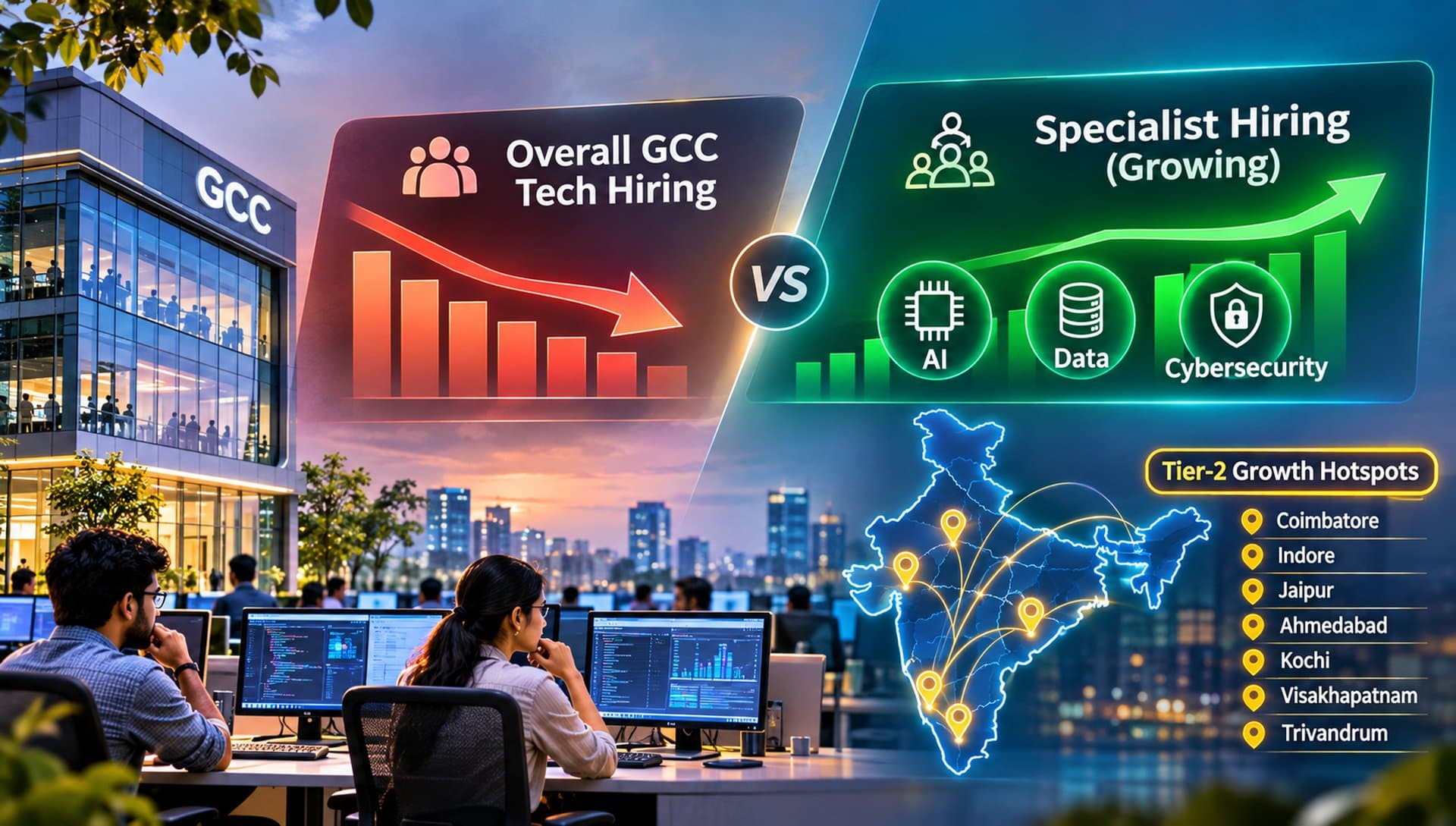
In the third quarter of FY27, Global Capability Centres (GCCs) in India experienced a paradoxical hiring trend: total technology recruitment dipped by 3.5% quarter-over-quarter, yet demand for specialists in AI, data analytics, and cybersecurity surged by 12-14% (Quess Corp). This contrast reveals a nuanced shift in enterprise hiring, a selective focus on advanced capabilities amid a broader slowdown. While GCCs historically expanded through scalable delivery and operations roles, the current movement emphasizes ownership of product development, data-driven insights, risk management, and enterprise governance. The hiring mix’s evolving quality, not just quantity, shapes the future trajectory for GCCs and their talent pipelines.
Why This Shift Matters: The Strategic Pivot of GCCs
This selective hiring pattern signals a strategic realignment in the GCC model. Enterprises are transitioning from cost-efficient service delivery units to innovation hubs owning complex technology domains: AI-powered products, cloud security platforms, and operational analytics (Business Standard, 2026). The fact that AI, data analytics, and cybersecurity roles now constitute over 30% of technology hiring demand (up from 25.8%) underlines the increasing value assigned to specialized skills that enable data-driven business outcomes and robust risk governance.
Moreover, the expanding roles in cybersecurity reflect enterprises’ heightened sensitivity to digital risks, especially as cloud and AI integrations deepen. The rise of analytics and AI positions points to the growing reliance on data platforms that optimize decisions — whether in retail inventory management, fraud detection, or service automation. This evolution requires GCCs not only to recruit selectively but to build depth in domain and business context understanding alongside technical expertise.
Business Implications: Capability Depth and Governance Take Center Stage
The selective hiring in AI, data, and cybersecurity reshapes the value chain within GCCs. Rather than broadly scaling operational headcount, organisations are prioritizing roles that can own product features, platform reliability, and integrated risk monitoring. This shift demands tighter governance, measurable business outcomes, and enhanced cross-functional collaboration. For instance, AI specialists must work closely with business analysts and product owners to implement applied AI solutions that respect enterprise risk controls and integrate seamlessly into workflows.
Operational efficiency is now inseparable from outcome ownership: GCCs are expected to deliver end-to-end value that supports global teams and enterprise mandates. Tier-2 cities like Coimbatore registering 30% growth in demand reveal that this advanced capability expansion is not confined to metropolitan hubs, enabling a more distributed talent ecosystem aligned with cost and governance priorities.
Role and Skills Implications: From Technical Foundations to Business-Facing Specialists
For students and professionals eyeing GCC careers, these developments offer critical directional insights. The trajectory typically moves from early-career roles focusing on foundational skills - data engineering, platform development, and cloud infrastructure, towards specialist roles in AI model tuning, cybersecurity risk analytics, and product engineering. Finally, career progression entails acquiring business-facing leadership capabilities: strategic communication, cross-functional decision-making, and governance oversight.
The reported talent supply gaps, estimated at 38-42% for AI/data roles and 30-35% for cybersecurity, underscore an urgent demand for continuous, applied learning that goes beyond certifications. GCCs prioritize candidates who marry technology fluency with domain expertise and enterprise integration skills. For example, an AI specialist developing fraud detection algorithms must collaborate with business analysts to contextualize risk models, ensuring compliance and practical effectiveness.
Equally important is the ability to practice responsible AI implementing model monitoring and alignment with ethical standards, within the broader enterprise architecture. This demands learning pathways that balance technical mastery with business context, risk awareness, and governance principles.
Omnivance Perspective: Moving Beyond Certifications to Applied Enterprise Capability
Reports correctly highlight the high demand for AI, cybersecurity, and data roles, yet the real story is in selective hiring driven by enterprise maturity and outcome ownership. GCCs no longer simply scale technical talent; they cultivate strategic capabilities that advance global digital transformations. This requires learning and career growth models centered on applied AI knowledge, industry-specific understanding, and the leadership skills to navigate complex governance environments.
We advocate a learning philosophy emphasizing role-specific skill sets blended with business insight: students and professionals must build fluency in applied analytics, enterprise AI integration, cybersecurity frameworks, and cloud platform engineering, all anchored in measurable business outcomes and governance adherence. Internal mobility within GCCs also enables specialists to evolve towards product ownership and business-impact roles, reinforcing a virtuous talent cycle tailored to selective, critical hiring needs.
The rise in Tier-2 hiring further suggests that scalable, remote, and hybrid working models broaden access to specialist roles beyond traditional urban hubs, offering wider pathways for emerging talent to contribute meaningfully to enterprise mandates.
Takeaway: Prepare for Selective, Outcome-Centric Roles in Advanced Technologies
For those entering or growing their careers in GCCs, the imperative is clear: specialize deliberately in AI, data analytics, cybersecurity, or cloud engineering while developing strong business collaboration and governance capabilities. Focused skills in applied AI monitoring, integrated risk management, and platform reliability will distinguish candidates in a competitive market with persistent supply gaps.
Understanding how these technologies create tangible business outcomes and how to manage related risks will empower professionals to lead GCCs’ evolution from scalable operations to strategic enterprise capabilities. Engaging with learning pathways that integrate technical, business, and ethical dimensions prepares talent to meet this complex demand confidently.
Actionable reflection: Assess your current skills against emerging specialist role requirements and seek applied learning opportunities that connect technology with business outcomes, governance, and ethical AI use. Leveraging training programs that focus on AI model deployment, cybersecurity resilience, and cross-functional communication will position you for success in the evolving GCC landscape.
Sources
Quess Corp India GCC Tech Talent Landscape Q2 FY27 (Jul–Sep 2026) https://www.quesscorp.com/reports/indias-gcc-tech-talent-landscape-q2-fy27/
Business Standard, “AI, data and cybersecurity drive 3 in 10 GCC tech hiring demand: report,” Nov 5, 2026 https://www.business-standard.com/amp/industry/news/ai-data-and-cybersecurity-drive-3-in-10-gcc-tech-hiring-demand-report-126110501019_1.html?isa=yes
Tags
Share this article

Omnivance Research Team
Dedicated to bridging the gap between education and industry requirements.
Related Courses
Deepen your knowledge with these recommended courses