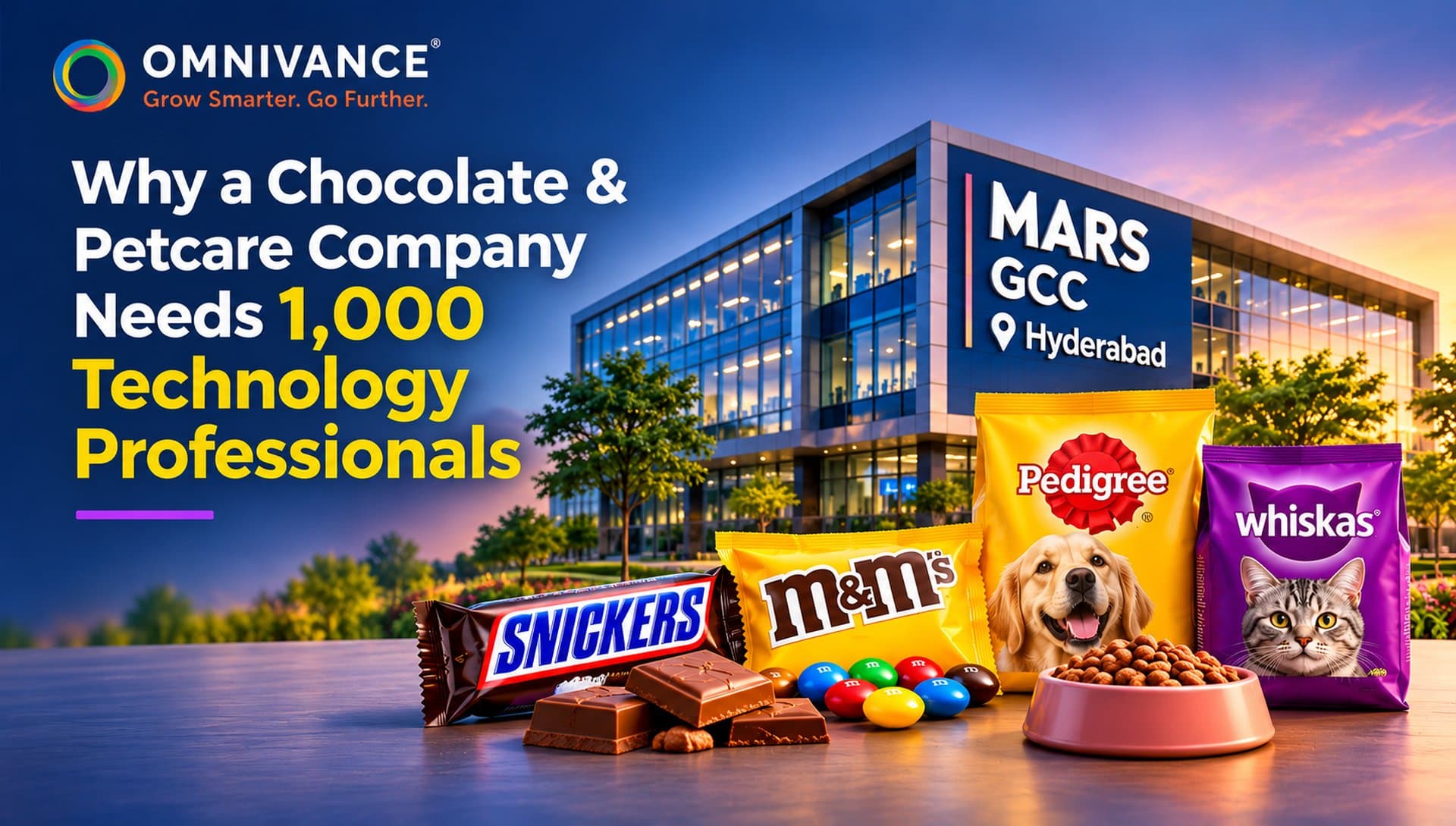

Why a Chocolate and Petcare Company Needs 1,000 Technology Professionals
What Mars' new Hyderabad GCC reveals about the changing relationship between industries, technology, and careers.
When you hear the name Mars, what comes to mind? Perhaps a Snickers chocolate bar. Maybe M&M's. Or petcare brands such as Pedigree and Whiskas. Software engineering, cloud computing, artificial intelligence, and data analytics probably aren't the first things you associate with the company.
Yet, on November 12, 2026, Mars inaugurated a Global Capability Centre (GCC) in Hyderabad, in collaboration with Genpact, with ambitions to scale to 1,000 Mars associates. Why would a company famous for chocolates and petcare products need so many technology professionals? Because the future of almost every industry is being shaped as much by technology and intelligence as by the products it sells. And Mars offers a fascinating example of this transformation.
1. The News: Mars Is Building More Than a Technology Centre
Mars is a global business spanning snacking, food, pet nutrition, veterinary services, and diagnostics. Its new Hyderabad centre covers approximately 60,000 square feet and launches with more than 400 Genpact professionals, with a longer-term ambition to scale and transition to 1,000 Mars associates. The centre is intended to strengthen digital, data, artificial intelligence, and enterprise operations capabilities across Mars' global businesses.
What makes this particularly interesting is the collaboration with Genpact and the emphasis on agentic AI-enabled operations. This is not simply about adding another offshore technology delivery centre. It represents an opportunity to rethink how business processes are designed, how decisions are made, and how people and intelligent systems work together.
The distinction matters. Traditional outsourcing often focused on performing existing activities more efficiently. Modern GCCs increasingly have the opportunity to redesign the activities themselves.
2. What Does Technology Have to Do With Chocolate?
Imagine a chocolate bar travelling from raw material sourcing to a customer's shopping basket. Behind that seemingly simple product lies a complex chain of decisions. Where should raw materials be sourced? How much chocolate should a factory produce? How can quality remain consistent? Which distribution centres need inventory? How should demand change during festivals? What happens when transportation costs rise? Each question creates opportunities for technology.
Consider five illustrative applications.
| Business challenge | How technology can help |
|---|---|
| Predicting chocolate demand | AI forecasting using sales, seasonal, and market data |
| Maintaining product quality | Sensors, computer vision, and manufacturing analytics |
| Reducing supply-chain waste | Inventory optimization and predictive planning |
| Improving distribution | Route optimization and logistics analytics |
| Understanding consumers | Customer analytics and digital commerce intelligence |
These examples illustrate potential applications across the FMCG industry; they are not a confirmed list of projects assigned to Mars' Hyderabad GCC. The important lesson is that a physical product can have an extensive digital ecosystem supporting it. A chocolate bar may be manufactured in a factory, but hundreds of decisions behind it can be powered by data and software.
3. Petcare Makes the Technology Story Even More Interesting
Mars is not simply a confectionery company. Its petcare businesses span pet nutrition, veterinary services, and diagnostics. That creates an entirely different set of technology opportunities. Think about the information generated through pet nutrition research, veterinary consultations, diagnostic tests, hospital operations, and product distribution. Technology can potentially help connect these activities in meaningful ways.
For example:
Data analytics can help identify patterns in demand for different pet nutrition products.
AI-assisted diagnostic workflows can support veterinary professionals, subject to appropriate clinical validation and oversight.
Cloud platforms can connect operational information across veterinary networks.
Digital systems can improve appointment management, inventory planning, and customer experiences.
Predictive models can support supply-chain decisions across petcare businesses.
A professional working in such an environment may need to understand data engineering and AI, but also the fundamentals of animal nutrition, veterinary operations, or consumer behaviour. This creates an important distinction between knowing a technology and knowing how to apply it within an industry.
4. Why the GCC Model Matters
Global Capability Centres have evolved considerably. Historically, many centres focused on transactional support, application maintenance, finance operations, and standardized processes. Today, the scope can extend to enterprise platforms, advanced analytics, cybersecurity, engineering, product development, and AI-led transformation. Mars' Hyderabad investment reflects this broader opportunity. Its collaboration with Genpact combines knowledge of business processes with digital and AI capabilities.
The focus on agentic operations is especially significant. Unlike traditional automation, which follows predefined steps, agentic AI systems can be designed to coordinate multiple activities, use tools, interpret information, and recommend or execute actions within defined boundaries.
Consider a hypothetical supply-chain scenario.
- A shipment of raw materials is delayed.
- A traditional system may generate an alert.
- An AI-assisted workflow could potentially evaluate alternative suppliers, check available inventory, assess production schedules, estimate costs, and recommend corrective actions to a human decision-maker.
The value is not simply faster processing. It is the potential to connect multiple decisions across functions. However, the actual benefits depend on reliable data, integration with enterprise systems, appropriate controls, and human accountability. That is why the next generation of GCCs will require more than technical skills alone.
5. What Kinds of Professionals Will Such Companies Need?
A company like Mars can create opportunities for professionals from several backgrounds.
| Capability area | Illustrative roles | Business knowledge that adds value |
|---|---|---|
| Data and AI | Data engineer, AI engineer, data scientist | Demand forecasting, customer behaviour |
| Cloud and platforms | Cloud engineer, platform architect | Global enterprise operations |
| Enterprise applications | SAP consultant, business systems analyst | Manufacturing, procurement, finance |
| Cybersecurity | Security analyst, cloud security specialist | Enterprise risk, connected operations |
| Intelligent automation | Automation engineer, AI workflow specialist | Process design, operational efficiency |
| Business transformation | Business analyst, transformation consultant | FMCG value chains and operating models |
These are illustrative career pathways based on the capabilities involved, not a verified breakdown of Mars' 1,000 planned positions. The bigger opportunity is the emergence of hybrid professionals. A data engineer who understands supply-chain operations. A cybersecurity professional who understands connected manufacturing. A business analyst who understands both FMCG economics and enterprise technology. An AI specialist who can translate business challenges into measurable operational improvements.
Such combinations can make professionals valuable beyond their knowledge of individual tools.
6. The Real Career Lesson: Your Industry May Matter as Much as Your Technology
For years, students have often thought about careers in separate categories. Computer science graduates pursue technology companies. Commerce graduates pursue finance. Biotechnology graduates pursue healthcare or research. Management graduates pursue consulting, marketing, or operations.
But the boundaries are becoming less rigid. A food company can employ AI engineers. A pharmaceutical company can need cloud architects. A logistics company can build sophisticated software platforms. A retailer can require cybersecurity specialists. And a petcare company can create opportunities for data scientists and digital transformation professionals.
This does not mean every graduate needs to become a programmer. It means professionals increasingly benefit from understanding three interconnected dimensions:
- Industry intelligence: How does the business operate, create value, and make money?
- Technology intelligence: Which technologies can improve its products, processes, and decisions?
- Role intelligence: What problems does a particular professional solve, and what capabilities are required?
The intersection of these dimensions can create career pathways that are not immediately obvious from a company's products.
7. What This Means for Indian Talent
The Mars announcement is also relevant to India's evolving role in global business operations. India's opportunity is no longer limited to providing large pools of technology professionals. It increasingly includes combining technical expertise with industry knowledge, process intelligence, business transformation, and global operating responsibilities. But there is an important qualification.
A target of 1,000 associates does not necessarily mean 1,000 immediate new job openings. Mars has announced a phased ambition involving an initial Genpact workforce and future transition and expansion. The more meaningful signal is the type of capability the company intends to develop.
For students, this means exploring industries beyond the traditional list of technology employers. For working professionals, it means developing domain knowledge alongside technical specialization. For educational institutions, it raises a curriculum question: Are students learning technologies in isolation, or are they learning how those technologies solve real business problems? And for employers, it highlights the importance of building teams that can connect technology investments to measurable business outcomes.
8. The Omnivance Perspective: Careers Are Becoming Industry-Connected
At Omnivance, we believe career readiness should go beyond teaching isolated skills. A student learning Python should understand how it can support demand forecasting. A student learning SQL should understand how data is used in retail, banking, manufacturing, or healthcare. A student studying business analytics should understand how operational decisions affect revenue, cost, quality, and customer experience. And someone exploring AI should understand not only how an AI model works, but where it creates value, where it can fail, and how its outcomes should be measured.
This is why connecting industry intelligence, technology intelligence, and role intelligence is so important. Consider a student who wants to become a data analyst. Instead of learning only spreadsheets, SQL, and dashboards, imagine that student also understands how a global FMCG company forecasts product demand, monitors inventory, manages distribution, and measures profitability. The technical skills remain important. But the ability to apply those skills in a real business context makes the learning more meaningful. That is the shift from learning tools to understanding value.
The Bigger Question
Mars' Hyderabad GCC is an important business development. But the most interesting part of the story is not the proposed 1,000-person workforce. It is what those professionals may eventually help the company achieve. Better decisions. More connected operations. Greater visibility. Smarter processes. And potentially new ways of delivering value to customers and pet owners.
The chocolate bar on a supermarket shelf may look exactly the same. The technology ecosystem behind it could be transformed. The next time you think about a career in technology, don't just ask which technology company you want to join. Ask which industry you want to help transform.
Because tomorrow's technology careers may be hiding inside today's most familiar products.
Omnivance Insights | Connecting Industries, Technology, Skills and Future Careers.
Editorial note: This article combines verified details of Mars' November 2026 announcement with illustrative industry use cases and independent career analysis. Examples of potential technology applications and roles should not be interpreted as confirmed Mars projects or vacancies.
Tags
Share this article

Omnivance Research Team
Dedicated to bridging the gap between education and industry requirements.
Related Courses
Deepen your knowledge with these recommended courses