
How AI Shopping Agents Are Disrupting Retail Giants’ Advertising Models
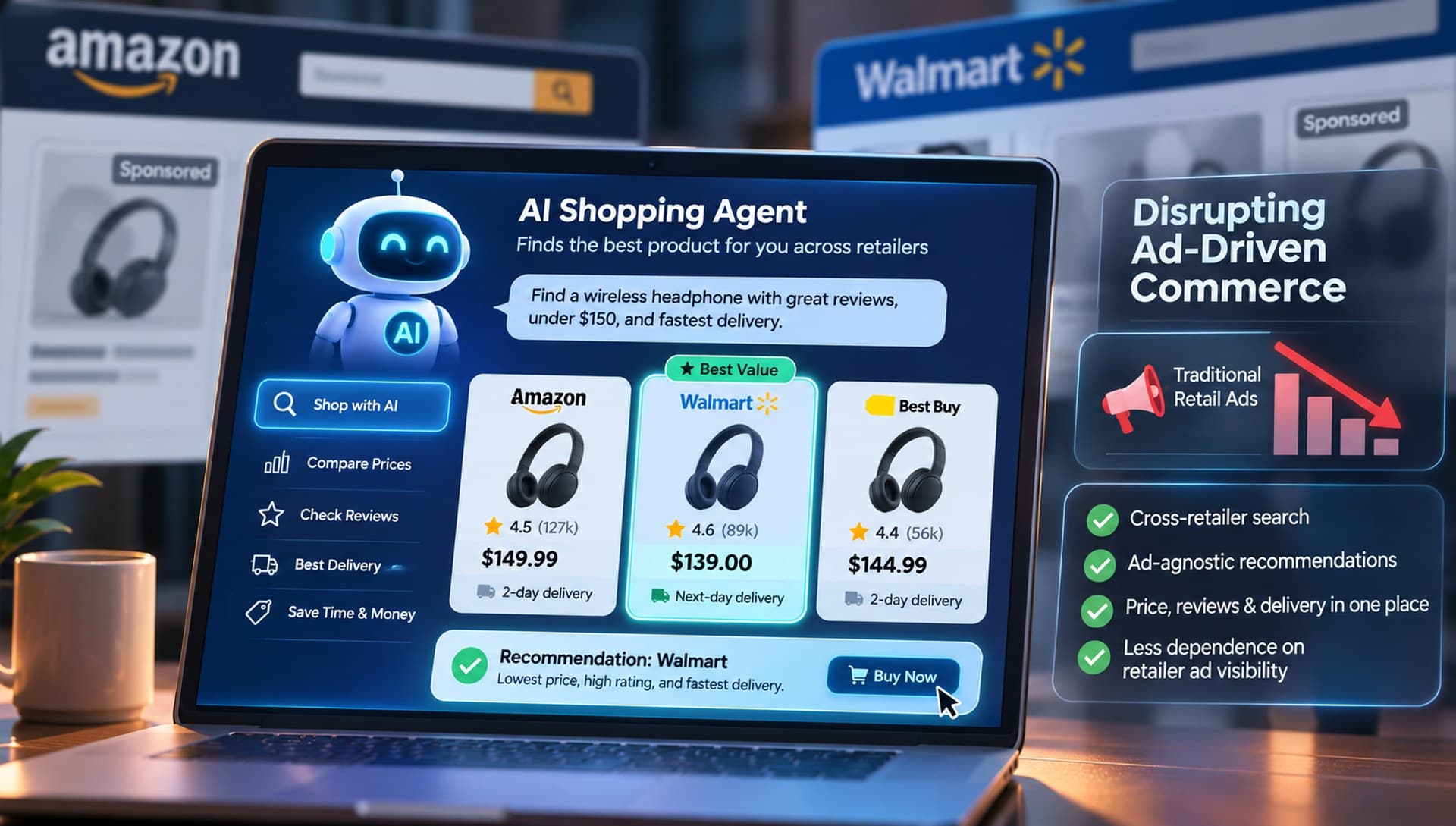
When AI shopping agents begin guiding consumers around the traditional digital storefronts of Amazon and Walmart, the resulting impact extends far beyond mere convenience. These agents, empowered by advances in natural language processing and real-time data integration, can autonomously select products across platforms to optimize price, selection, and personal preferences, effectively bypassing the retailers’ paid advertising ecosystems. This emerging reality raises a central business question for retail leaders and marketers alike: How will AI shopping agents reshape the control and profitability of the dominant retail advertising channels?
What Happened: The Rise of Autonomous AI Shopping Agents
According to a November 2026 report by Reuters, AI shopping agents are increasingly enabling shoppers to compare options and complete purchases outside the conventional e-commerce interfaces dominated by Amazon and Walmart. These agents leverage AI to parse countless listings, reviews, and prices, presenting consumers with tailored recommendations without navigating retailer-specific ads or sponsored products. The practical upshot is a diminished ability for Amazon and Walmart to monetize product placement through advertising fees, a key revenue source that traditionally subsidizes their low-cost retail strategies.
This shift is not merely a technological novelty. It represents a fundamental challenge to retailer-operated marketing ecosystems whose revenues depend heavily on steering consumer attention and purchase decisions through paid ads. The proliferation of AI intermediaries effectively “neutralizes” some of the advantages accrued from captive customer engagement on these platforms.
Why It Matters: The Commercial Stakes Behind AI Shopping Agents
Retailers like Amazon and Walmart have built vast advertising businesses integrated with their e-commerce platforms, controlling product visibility and consumer flows with precision. These ads influence billions in purchasing decisions and generate significant profits beyond direct product sales. Losing that influence to AI shopping agents could erode a sizeable chunk of high-margin advertising revenue.
The core tension is operational and strategic: how can retailers maintain relevance and visibility in the purchase journey when AI agents are incentivized to prioritize consumer value over loyalty to any single retailer? This challenges the traditional retail value chain, which bundles product assortment, advertising placement, and checkout within a controlled digital environment. Fragmentation through AI intermediaries complicates demand forecasting, pricing strategies, and advertising ROI measurement.
Consider a hypothetical global retail merchandiser using an AI agent to better understand competitive pricing and product trends across multiple sellers. If consumers routinely use third-party AI to circumvent on-platform ads, merchandising teams must rethink promotions and inventory strategies to reflect these ‘invisible’ competitive pressures.
Business Impact: Strategic and Operational Implications for Retailers
The immediate business impact is twofold: revenue risk from diminished advertising control, and operational complexity in marketing attribution and consumer engagement. Retailers may see decreased returns on sponsored placements as AI agents filter or bypass ads altogether.
To adapt, retailers need to expand their strategies beyond selling ad slots. This involves investing in AI and data analytics to enhance product quality signals, improve supply chain responsiveness, and harness consumer insights across aggregated channels where AI shopping agents operate. Retailers must also explore partnerships or integrations with AI agent platforms, transforming them from competitors into collaborators, thus regaining influence in the AI-managed purchase flow.
From a technology standpoint, building proprietary AI capabilities to personalize shopper experiences within and beyond their own platforms can differentiate retailers. Walmart, for instance, might deploy AI to optimize in-store stock dynamically alongside digital offers targeted at users interacting with external AI agents. Amazon might leverage its cloud and AI expertise to develop advanced shopping assistants that consumers prefer to use directly, keeping them within its ecosystem.
People and Skills: Evolving Roles in Retail AI and Product Ownership
These shifts signal evolving workforce priorities within retail enterprise centers and global capability centers (GCCs). Data engineers and AI specialists become vital for crafting models that understand agent-driven shopper behavior and predict its effects on sales and advertising performance. Product owners must recalibrate roadmaps to integrate AI agent intelligence, balancing business outcomes with technological innovation.
Business analysts gain prominence in navigating the blurring lines between AI-driven customer pathways and traditional sales funnels, needing cross-functional collaboration skills to connect marketing, operations, and analytics data. Cybersecurity analysts play a growing role as AI agents process sensitive consumer data, requiring vigilant governance to manage privacy and compliance risks.
Consider the hypothetical role of an AI product owner at a major retailer’s GCC tasked with integrating external AI agent data streams to refine real-time pricing algorithms. This specialist must combine data science savvy with sharp operational insight to maintain competitive advantage when direct advertising influence wanes.
Omnivance Interpretation: Navigating AI Agent-Driven Retail Complexity
The disruption from AI shopping agents underscores a broader strategic pivot in retail: from controlling surface-level customer engagement to mastering multilayered AI-augmented ecosystems. Retail leaders must move beyond incremental tech adoption and embrace a capability-driven approach that integrates AI insights deeply into product, marketing, and operational workflows.
Crucially, AI in retail is proving less about replacing human roles and more about augmenting complex decision-making with advanced analytics and data governance — enabling faster responses to dynamic market forces introduced by these autonomous shopping agents.
This evolution demands investment in cross-disciplinary skills and reshaped organizational roles within GCCs and enterprise centers. Business-facing AI specialists who can translate agent-driven data into measurable business outcomes will be especially critical. Those professionals equipped for collaboration across data, cybersecurity, and product teams will shape the next generation of retail value creation models.
What Retailers Should Ask Next
As AI shopping agents turn from novelty to norm, retail business leaders face a strategic inflection: How can they reconstruct their advertising and commerce models to thrive without controlling every click? Can retailers develop AI-enhanced value propositions that invite collaboration with shopping agents rather than compete against them? And finally, how can talent development programs prepare their workforce to navigate this complex, AI-driven buyer-seller dynamic while delivering measurable business advantage?
Sources: Tabassum, Juveria; Brown, Nicholas P.; McLymore, Arriana. “AI shopping agents could threaten Amazon and Walmart’s ad business.” Reuters, November 4, 2026. https://www.reuters.com/business/media-telecom/ai-shopping-agents-could-threaten-amazon-walmarts-ad-business-2026-11-04/
Tags
Share this article

Omnivance Research Team
Dedicated to bridging the gap between education and industry requirements.
Related Courses
Deepen your knowledge with these recommended courses