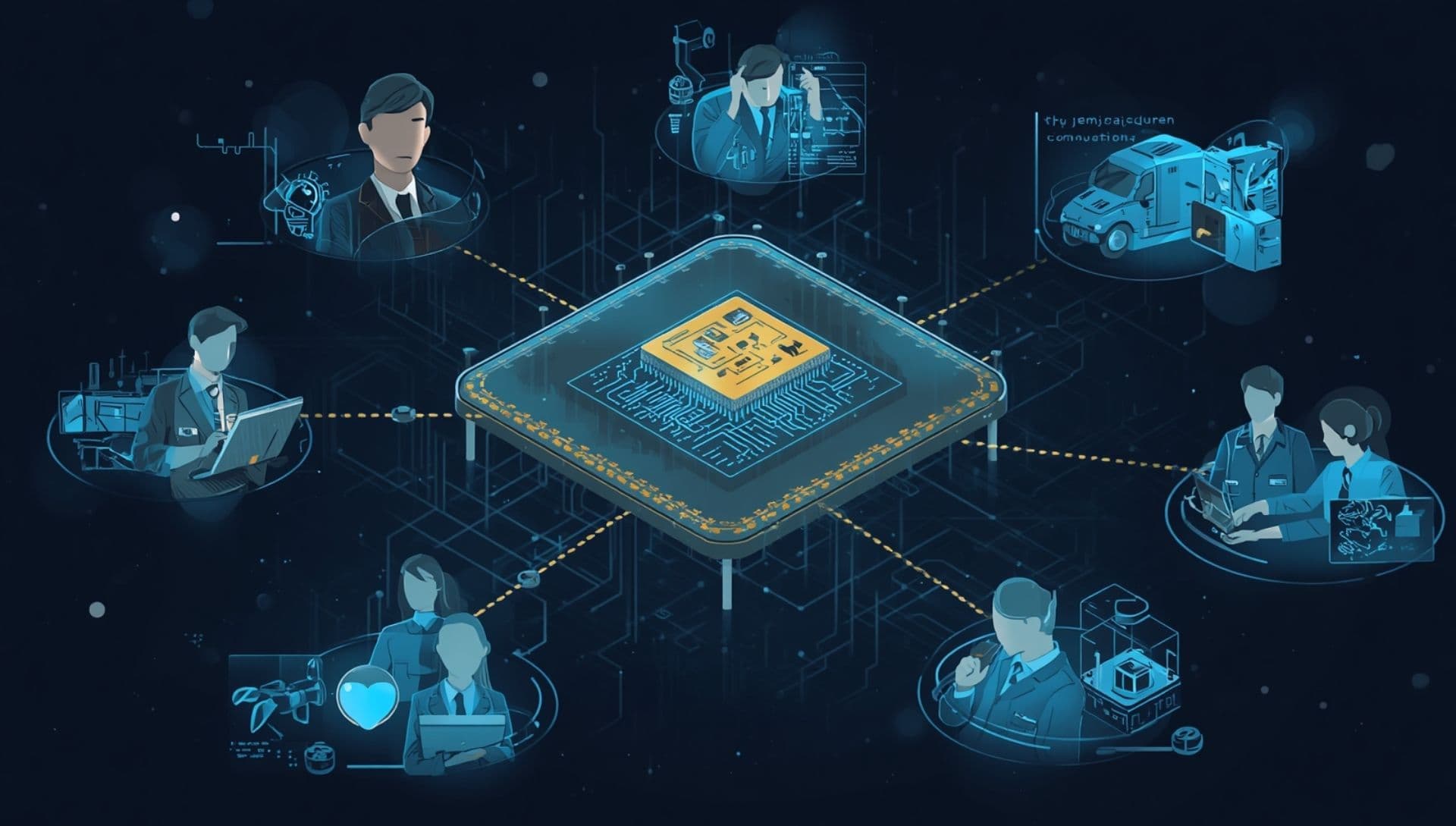

Imagine walking into one of the world's most advanced semiconductor manufacturing facilities.
Hundreds of engineers, scientists, technicians, software developers, data analysts, equipment specialists, supply chain experts, quality professionals, and business leaders are all working toward one common goal, producing tiny chips that will eventually power smartphones, electric vehicles, AI systems, satellites, medical devices, and even the laptop you may be reading this article on.
To someone visiting for the first time, it might seem overwhelming. Who designs the chip? Who manufactures it? Who ensures it works correctly? Who delivers it to customers? Who improves production yields? Who develops the next generation of technology?
The answer is simple.
Everyone does a different part of the journey.
That is perhaps the most fascinating aspect of the semiconductor industry. Success is never created by a single brilliant engineer or one breakthrough invention. It is the result of thousands of highly specialized professionals working together across research, design, manufacturing, testing, business operations, customer support, and innovation. Every role contributes a unique piece of a much larger puzzle.
For students exploring career options, professionals considering a transition into semiconductors, or engineers trying to understand where they fit within the industry, the sheer number of roles can sometimes feel confusing. Many people assume semiconductor careers are limited to chip design or factory operations. In reality, the industry offers one of the broadest ranges of technical, business, and leadership careers available anywhere.
Understanding these roles is not simply about choosing a job title. It is about understanding how an entire industry transforms scientific ideas into technologies that power modern civilization.
A Semiconductor Company Is Like a Living Ecosystem
Every semiconductor company begins with an idea.
Perhaps a customer needs a faster AI processor. An automotive company wants a safer autonomous driving chip. A smartphone manufacturer requires lower power consumption. A cloud provider needs higher-performance data center processors.
Turning that idea into millions of reliable chips requires dozens of specialized teams working together over several years.
A simplified view of the semiconductor value chain looks like this:
| Business Stage | Primary Functional Areas | Example Roles |
|---|---|---|
| Research & Innovation | Advanced Research | Research Scientist, Device Engineer |
| Product Definition | Product Planning | Product Manager, System Architect |
| Chip Design | IC Design | Design Engineer, Verification Engineer |
| Physical Implementation | Layout & Physical Design | Physical Design Engineer |
| Manufacturing | Wafer Fabrication | Process Engineer, Equipment Engineer |
| Testing | Validation & Test | Test Engineer, Product Engineer |
| Packaging | Assembly | Packaging Engineer |
| Quality & Reliability | Product Quality | Quality Engineer, Reliability Engineer |
| Supply Chain | Operations | Planning, Procurement, Logistics |
| Customer Support | Applications | Field Application Engineer, Technical Marketing |
| Business Leadership | Strategy | Program Manager, Engineering Manager, Business Leader |
Although these functions appear separate on paper, they are deeply interconnected. A design engineer depends on process engineers. Manufacturing depends on equipment specialists. Quality engineers collaborate with test engineers. Product managers continuously gather customer feedback that influences the next generation of chip designs.
Understanding these connections is often more valuable than memorizing job titles.
The Architects of Innovation: Research, Product Planning, and Chip Design
Every successful semiconductor product begins long before the first wafer enters a fabrication plant.
Research scientists explore new transistor architectures, materials, lithography techniques, and manufacturing technologies that may not become commercial products for another decade. Their work pushes the boundaries of physics and engineering while preparing the industry for future demands such as AI computing, quantum technologies, and advanced memory.
Once promising technologies emerge, system architects and product managers begin translating customer needs into technical requirements. Their role combines engineering with business thinking. They constantly ask questions such as:
What problem are customers trying to solve?
How much performance is required?
What power consumption is acceptable?
How much should the chip cost?
Which competitors are entering this market?
This combination of market understanding and technical knowledge guides the direction of product development.
Chip design engineers then transform these requirements into detailed digital circuits. They design processors, memory controllers, communication interfaces, AI accelerators, analog circuits, power management systems, and many other functional blocks.
Alongside them work verification engineers, whose responsibility is equally important. Designing a chip is only half the challenge. Proving that every circuit behaves correctly under millions of operating conditions often requires even more engineering effort than the design itself.
Physical design engineers then convert logical circuit designs into physical layouts that can actually be manufactured on silicon wafers while meeting strict timing, power, and area requirements.
These roles attract individuals who enjoy mathematics, computer architecture, electronics, programming, logical reasoning, and solving highly complex technical problems.
Manufacturing Excellence: Where Engineering Meets Precision
Once the design is complete, manufacturing becomes the heart of the semiconductor value chain.
Modern wafer fabrication facilities are among the most sophisticated manufacturing environments ever built. Producing a single chip involves hundreds or even thousands of precisely controlled process steps.
Here, process engineers play one of the industry's most influential roles. Their responsibility is to continuously optimize manufacturing recipes that create microscopic transistor structures measured in nanometers. Even tiny process variations can significantly affect product quality and manufacturing yield.
Working alongside them are equipment engineers who ensure advanced manufacturing tools operate with exceptional reliability. Semiconductor fabrication equipment costs millions of dollars, and every minute of downtime affects production schedules, customer commitments, and company profitability.
Manufacturing engineers coordinate production activities, monitor factory performance, improve operational efficiency, and solve day-to-day manufacturing challenges.
Increasingly, these professionals also work with AI-powered monitoring systems, predictive maintenance models, digital twins, and smart factory technologies that help detect problems before they occur.
These careers suit professionals who enjoy solving practical engineering challenges, working with advanced equipment, analyzing production data, and continuously improving operational performance.
Testing, Packaging, and Quality: Protecting Customer Trust
Designing and manufacturing a chip does not automatically guarantee that it will perform reliably inside an electric vehicle, medical device, or aircraft.
Every semiconductor product undergoes extensive testing before reaching customers.
Test engineers develop sophisticated testing methodologies that verify functionality, performance, power consumption, timing characteristics, and reliability. Product engineers analyze test results, investigate failures, improve yields, and ensure manufacturing quality remains consistently high.
Packaging engineers focus on another rapidly evolving area of the industry. Modern chips are no longer simply enclosed inside protective packages. Advanced packaging technologies—including 2.5D integration, 3D stacking, chiplets, and heterogeneous integration—have become major sources of competitive advantage.
Quality engineers oversee the entire product lifecycle, ensuring manufacturing processes consistently meet customer expectations and international quality standards. Reliability engineers perform stress testing that simulates years of product usage in a much shorter timeframe, helping ensure chips continue operating under extreme temperatures, humidity, vibration, and electrical conditions.
For professionals who enjoy analytical thinking, root cause analysis, statistical methods, and continuous improvement, these roles provide opportunities to directly influence customer satisfaction and product reliability.
The Business Functions That Keep Innovation Moving
When people imagine semiconductor careers, they often picture engineers in laboratories or fabrication facilities. Yet every successful semiconductor company also depends on professionals who connect technology with customers, suppliers, investors, regulators, and global markets.
Supply chain professionals coordinate the movement of raw materials, manufacturing capacity, outsourced assembly partners, testing facilities, and finished products across multiple countries. In an industry where geopolitical events, natural disasters, and logistics disruptions can impact global supply, resilient supply chain management has become a strategic capability.
Procurement specialists negotiate with equipment vendors and material suppliers while balancing cost, quality, delivery timelines, and long-term partnerships.
Program managers coordinate cross-functional teams throughout product development, ensuring technical milestones, budgets, customer commitments, and manufacturing readiness remain aligned.
Field Application Engineers (FAEs) work directly with customers, helping them integrate semiconductor products into their systems while solving technical implementation challenges. Their role combines deep engineering knowledge with excellent communication and relationship-building skills.
Technical marketing professionals bridge engineering and business by explaining complex semiconductor technologies in ways customers can understand while gathering market feedback that shapes future products.
Sales professionals, business development managers, finance specialists, legal experts, cybersecurity professionals, human resources teams, and sustainability leaders all contribute to delivering customer value even though they may never directly design or manufacture a chip.
The semiconductor industry succeeds because technology and business evolve together.
How All These Roles Work Together
Understanding individual roles becomes much easier when viewed as one connected workflow.
Customer Need
       │
       ▼
Product Manager
       │
       ▼
System Architect
       │
       ▼
Design Engineers
       │
       ▼
Verification Engineers
       │
       ▼
Physical Design
       │
       ▼
Wafer Manufacturing
       │
       ▼
Testing & Packaging
       │
       ▼
Quality Assurance
       │
       ▼
Supply Chain
       │
       ▼
Customer Delivery
       │
       ▼
Field Support & Continuous Improvement
Notice that no single function operates independently. Information continuously flows backward as well as forward. Customer feedback influences future product planning. Manufacturing challenges inspire design improvements. Test failures reveal opportunities for process optimization.
This cross-functional collaboration is one of the defining characteristics of successful semiconductor organizations.
Choosing the Right Role for Your Strengths
Different personalities naturally thrive in different environments. There is no single "best" career in semiconductors. The right role depends on what kind of problems you enjoy solving every day.
| If You Enjoy... | Roles to Explore |
|---|---|
| Mathematics, algorithms, logic | Design Engineer, Verification Engineer |
| Research and innovation | Research Scientist, Device Engineer |
| Manufacturing and operations | Process Engineer, Manufacturing Engineer |
| Machines and automation | Equipment Engineer |
| Data analysis and optimization | Yield Engineer, Product Engineer |
| Quality and reliability | Quality Engineer, Reliability Engineer |
| Customer interaction | Field Application Engineer, Technical Marketing |
| Planning and coordination | Program Manager, Operations Manager |
| Business strategy | Product Manager, Business Development |
| Leadership | Engineering Manager, Director, Vice President |
Rather than asking, "Which role pays the highest salary?" a better question is, "Which type of problem would I enjoy solving for the next ten years?"
Long-term career satisfaction almost always comes from solving problems you genuinely enjoy.
How Artificial Intelligence Is Reshaping Every Semiconductor Role
Artificial intelligence is transforming nearly every function across the semiconductor industry, not by replacing professionals but by making them significantly more capable.
Design engineers increasingly use AI-assisted Electronic Design Automation (EDA) tools to accelerate circuit optimization. Verification teams use intelligent automation to generate more comprehensive test scenarios. Manufacturing engineers analyze enormous volumes of sensor data to predict equipment failures before they occur. Quality engineers use machine learning to identify defect patterns that would be difficult for humans to detect manually.
Supply chain teams use AI to forecast demand, optimize inventory, and respond more quickly to global disruptions. Customer-facing professionals use AI-powered knowledge systems to resolve technical issues faster and provide more personalized support.
The common pattern across all these roles is clear. Professionals who combine strong semiconductor expertise with AI literacy will be better positioned to innovate, make faster decisions, and create greater business value.
Human judgment, engineering creativity, ethical decision-making, customer understanding, and cross-functional collaboration remain essential. AI amplifies these capabilities rather than replacing them.
Careers Grow Across Functions, Not Just Upward
One of the biggest misconceptions about careers is that success always means climbing a traditional management ladder.
The semiconductor industry demonstrates a very different reality.
A design engineer may become a technical architect. A process engineer may transition into yield engineering. A test engineer may move into product management. A manufacturing leader may eventually oversee global operations. Some professionals become distinguished technical fellows, while others build careers in customer strategy, innovation management, consulting, or entrepreneurship.
As professionals gain experience, they often expand beyond technical specialization by developing business understanding, financial awareness, leadership capabilities, communication skills, and customer engagement. These interdisciplinary experiences create some of the industry's most influential leaders because they understand how technology, manufacturing, business, and customers connect.
Career growth, therefore, is not simply about earning a new title. It is about increasing the value you can create across the semiconductor ecosystem.
The Bigger Picture
Every smartphone unlocked with facial recognition, every electric vehicle navigating city streets, every AI model answering questions, every medical scanner diagnosing disease, and every satellite orbiting Earth depends on semiconductor technologies built by thousands of professionals working across dozens of interconnected roles.
Some of these professionals spend their careers designing tiny transistors. Others optimize manufacturing processes, improve product quality, manage global supply chains, support customers, or define future product strategies. Individually, each role may seem specialized. Together, they enable one of the world's most strategically important industries.
If you are exploring a career in semiconductors, do not focus only on finding the "right job title." Focus on understanding how value is created across the entire ecosystem. The more you appreciate how different roles connect, the more opportunities you will discover for learning, collaboration, and long-term career growth.
Capability almost always grows faster than titles. As your understanding expands beyond your own specialization, your ability to contribute also grows—and that is what ultimately shapes a meaningful and resilient career.
Reflection Question
Which semiconductor role aligns most closely with the kind of problems you naturally enjoy solving, and what knowledge or skills would you need to begin preparing for that path today?
Continue Your Learning Journey
Now that you understand the major roles within the semiconductor industry, the next natural step is to explore the skills, qualifications, certifications, and learning roadmap required to build a successful career in each of these roles.
Tags
Share this article

Omnivance Research Team
Dedicated to bridging the gap between education and industry requirements.
Related Courses
Deepen your knowledge with these recommended courses